
The forces of modernisation and globalisation have advanced rapidly with the advent of the digital age. They have brought considerable benefits and convenience to human life; yet, often without our awareness, technology has gradually begun to harm both human beings and humanity itself. The food, pharmaceutical, arms, and other industries have in many cases taken more lives than they have preserved. Communication technology provides unprecedented convenience, but it also creates new opportunities for fraud, corruption, manipulation, and other abuses. Technological automation, the emergence of artificial intelligence (AI), and widespread digitalisation have also disrupted education, transformed how knowledge is acquired, and contributed to misinformation and polarisation. Conventional education, with its narrow emphasis on memorisation and cognitive or intellectual ability (IQ), is increasingly being displaced or superseded by artificial intelligence.
This situation suggests that conventional educational systems are no longer adequate to address the complexities of the modern age. More critically, conventional educational institutions may have lost their function as agents for developing well-rounded individuals who possess mental resilience, moral integrity, and intellectual strength. Many young people have become alienated from their surroundings, unable to make sense of the world in which they live, and increasingly vulnerable in maintaining their identities and religious convictions.
What is needed today is an alternative educational system that cultivates intellectual (IQ), emotional (EQ), and spiritual (SQ) intelligence alongside social, ethical, and aesthetic capacities. Such a system is holistic education, which integrates the balanced development of the full range of human potential, thereby equipping learners with the mental resilience and adaptability required to confront the complexities of real-life problems in society.
In social life, holistic education can foster empathy and moral integrity amid the overwhelming flow of global information and the erosion of social values. Individuals educated holistically are better able to adapt to changes in their professional lives because they possess mental resilience and strong social skills. They are less likely to give up, succumb to despair, or become overwhelmed by stress when confronted with failure and life’s pressures. At the individual level, holistic education cultivates critical thinking, creativity, collaboration, and communication—capacities that conventional education alone cannot adequately develop.
In Indonesia, an Islamic educational institution has long practised holistic education, largely unnoticed. Known as the pondok pesantren, it is a privately administered, fully residential institution. This traditional form of Islamic education has developed throughout the Malay-Indonesian Archipelago since the sixteenth century and continues to flourish today.
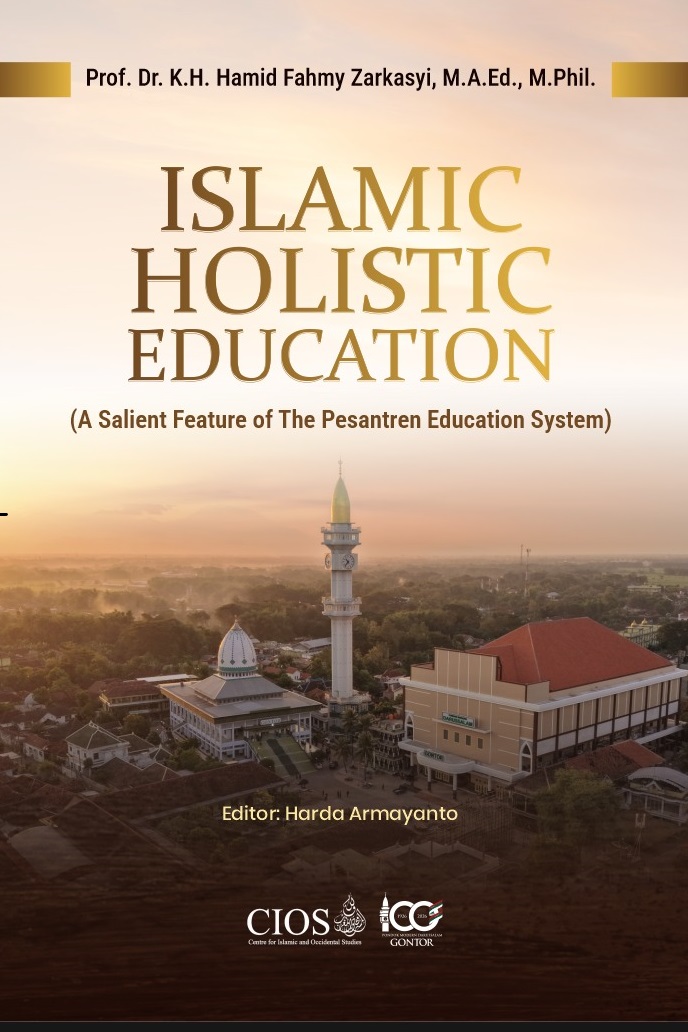
This book explores and reveals the practice of holistic education within pesantren that have adopted a modern educational system. Modern pesantren have successfully combined three curricular domains—intracurricular, cocurricular, and extracurricular activities—within a single system. It has also integrated formal, nonformal, and informal education on one campus, creating an environment that simultaneously functions as a school, a home, and a community.
Within this Islamic education institution, the pillars of holistic education formulated by UNESCO have been effectively implemented, while the comprehensive values of Islamic teachings have further enriched its principles. This modest book is simply an attempt to share this educational experience with a world that requires cooperation in all that benefits humanity. Islam teaches that the best person is one who brings the greatest benefit to the greatest number of people.
